
Pipestone County Arrest Records and Court Charges
Pipestone County arrest records and court charge records come from different parts of the justice process. The sheriff and jail side may show who is in custody, a booking number, intake date, age, sex, photo, current charge rows, offense level, status, statute, and short charge description. The court side begins when a complaint, citation, or other charging document is filed in Pipestone County District Court. From that point forward, the court record tracks the charge, hearings, plea, disposition, and sentence.
The official custody list is useful for current custody. The full court case file is different. It can include filed charges, amended counts, dismissed counts, plea events, and sentence terms. For the complete criminal case outcome, use Pipestone County criminal court records. For booking and jail roster detail, the inmate records page and the custody list are the more direct source.
The Pipestone County Jail custody list is the official county-linked custody source for current jail rows.
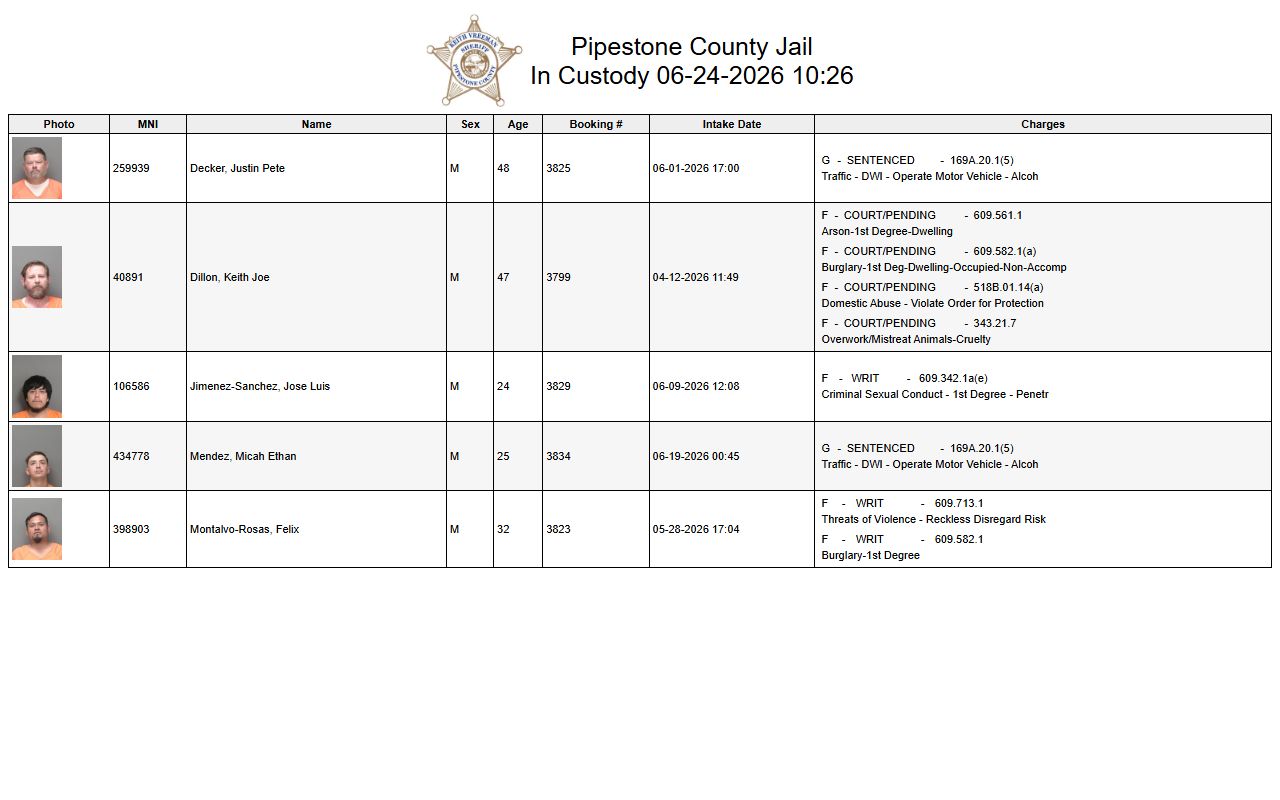
The custody list is relevant because it shows current jail rows and charge descriptions, but it does not replace the filed court case record.
Search Pipestone County Arrest Records and Charges
Start with the record type needed. Current custody and booking rows come from the county-linked jail custody table. Filed charges and court status come from MCRO Case Search. Conviction-level criminal history comes from Minnesota BCA Public Criminal History Search. Sheriff reports, arrest data not visible online, or incident records use the Pipestone County Sheriff's Office records request channel.
- Check the Pipestone County custody list for current jail and booking rows.
- Use MCRO Case Search by case number or citation number for pending criminal charges.
- Use defendant name only when MCRO allows name searching for the criminal case.
- Open the case and read each charge row, offense level, plea, status, and disposition.
- Use BCA public criminal history for conviction-level history, not every arrest or pending charge.
- Request sheriff records for arrest or incident data not shown in the public table.
Pending criminal cases have a key search limit in MCRO. The FAQ says they cannot be searched by defendant name until conviction. That makes case numbers and citation numbers especially important for court charges after arrest.
Pipestone County Charges After Arrest
After an arrest, the prosecutor decides what formal charges, if any, will be filed. In Pipestone County, the county attorney prosecutes adult felonies and gross misdemeanors, misdemeanor and traffic violations outside city limits, juvenile delinquency, child protection, and civil commitment matters. The charging record may begin with a complaint, citation, or other formal filing. Research instructions listed complaint, information, and indictment as the charging-document types to explain, but the local Minnesota research specifically supports complaints and citations in court records. Information and indictment are included here only as general charging forms, not as locally documented Pipestone County examples.
| Document Type | Filed By | Common Role | Pipestone County Note |
|---|---|---|---|
| Complaint | Prosecutor or charging authority | Starts or states criminal counts in District Court. | Criminal files in the research include complaints and charge rows. |
| Information | Prosecutor | Formal charge document used in some criminal procedures. | No local example was documented in the research file. |
| Indictment | Grand jury | Formal accusation for serious criminal matters. | No local Pipestone County indictment example was documented. |
| Citation | Law enforcement | Ticket or charging notice that may become a court case. | MCRO and WebPay support citation-number searches. |
This distinction keeps arrest records separate from court charges. An arrest can happen before a filed complaint appears in court. A filed charge can also be amended, reduced, dismissed, or resolved in a way that differs from the initial custody row.
Pipestone County Charge Status
Charge status describes where a count stands in the court process. The Pipestone County custody list may show statuses such as sentenced or court/pending for a person held in jail. MCRO court records can show more complete charge progress, including plea, disposition, sentence, and docket events. Read the current status, final disposition, and sentence together before treating a charge as a conviction.
| Status | What It Means |
|---|---|
| Pending | The charge or case is still active and has not reached final disposition. |
| Amended | The filed charge was changed, often to a different count, level, or wording. |
| Reduced | The charge level or count was lowered as part of the case process. |
| Dismissed | The charge ended without the conviction sought on that count. |
| Sentenced | A conviction or court result has led to sentence terms such as jail, probation, fines, or restitution. |
Minnesota law-enforcement data law helps explain why sheriff arrest data and court charge data are not the same record set.
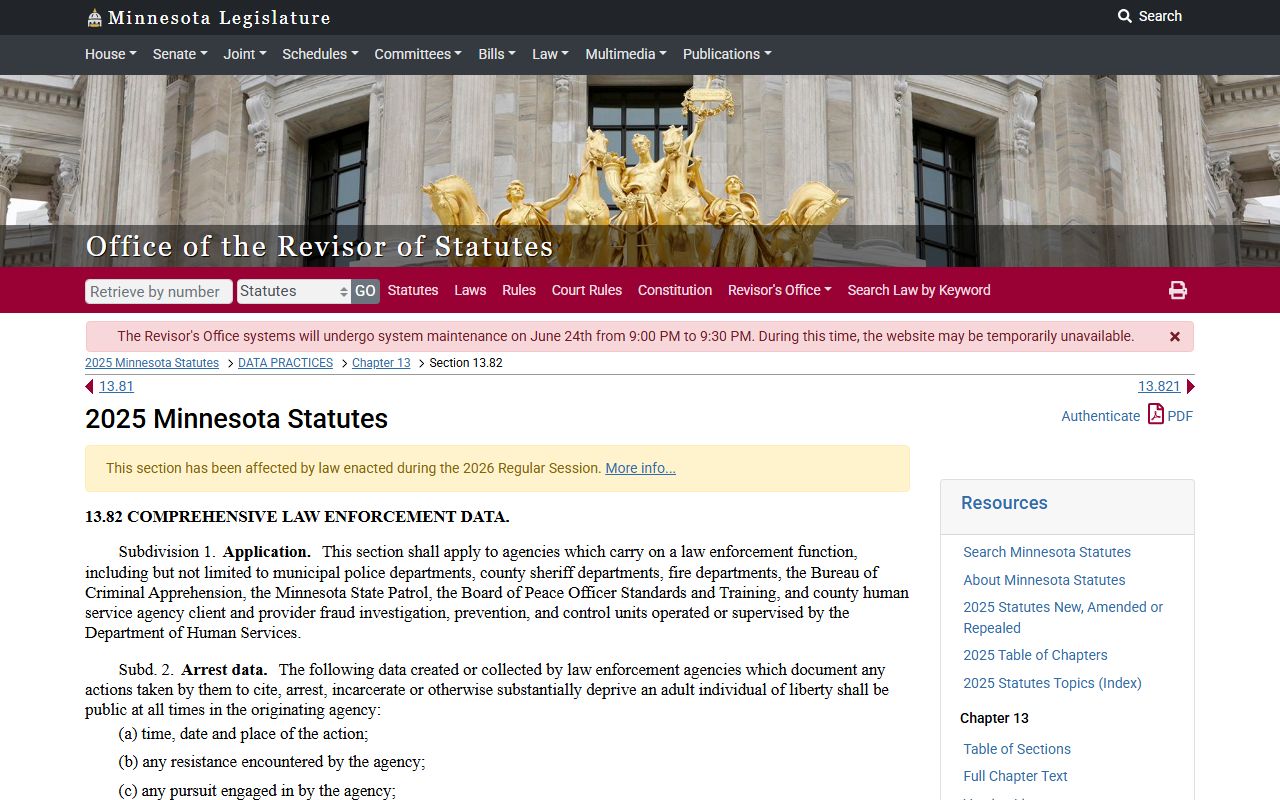
Section 13.82 helps explain why arrest, request-for-service, investigation, victim, and related law-enforcement data can have classifications that differ from court records.
Pipestone County Charges vs Convictions
A filed charge is not the same as a conviction. Pipestone County arrest records may show a person was booked on a charge row. The court case may later show a dismissed count, amended charge, plea to a different count, conviction, acquittal, or sentence. BCA public criminal history is conviction-focused and should not be used as a complete list of arrests or pending charges.
| Charge | Conviction | |
|---|---|---|
| Meaning | An accusation filed or listed after arrest. | A guilty result by plea, verdict, or finding. |
| Where It Appears | Custody charge rows, MCRO charge rows, complaints, citations. | MCRO disposition and sentence, BCA conviction history. |
| Can Change | Yes, it may be amended, reduced, or dismissed. | May later be sealed or expunged if the law allows. |
| Use With Care | Do not treat it as guilt. | Verify the exact count and sentence from the court source. |
Pipestone County Charge Codes
Charge rows often include a statute citation, offense level, and short description. The custody-list research found visible offense level abbreviations and examples such as felony and gross misdemeanor rows, plus statute examples including DWI, arson, burglary, domestic abuse order violation, and animal mistreatment statutes. Court records may include more detail than the custody table, including count number, plea, disposition, conviction level, and sentence terms.
One arrest can produce more than one charge. One court case can also include charges that end differently. Charge codes should therefore be read with the case number, count status, plea, disposition, and sentence. If the court record and the custody list appear to conflict, verify the current case status through Court Administration or the Sheriff's Office, depending on the record type.
Statewide Arrest and Charge Lookups
Minnesota has several statewide systems, but each answers a different question. MCRO searches district court cases and charge rows. The BCA Public Criminal History Search covers public conviction history. The Minnesota DOC public offender locator covers people sentenced to or supervised by the state correctional system. Minnesota VINE provides custody and criminal-case notification tools. None of these is a single complete arrest-record database for every Pipestone County arrest.
For sheriff records not visible through the custody list, use the county records-request process. The sheriff records page links to data classification information and a data request form. That path is important for incident reports or arrest-related law-enforcement data that do not appear in the public custody table.
Sealed or Expunged Arrest Records
Sealing and expungement can affect what the public sees. Minnesota law includes traditional expungement eligibility under Minn. Stat. section 609A.02, petition procedure under section 609A.03, and automatic expungement for qualifying records under section 609A.015. Juvenile, child protection, domestic abuse, harassment, civil commitment, sealed, and expunged records may be unavailable to the general public.
| Sealed | Expunged | |
|---|---|---|
| Public Visibility | Hidden from ordinary public access. | Removed or limited from public access after statute or court order applies. |
| Record Type | Can involve court, juvenile, protected, or confidential data. | Often discussed with criminal cases and qualifying records. |
| Agency Access | May remain available to authorized users. | May remain available where Minnesota law permits. |
| Local Check | Ask Court Administration or the Sheriff, based on record type. | Check the court case and statute before assuming public removal. |
Minnesota expungement petition procedure governs many court-filed requests to limit public access.
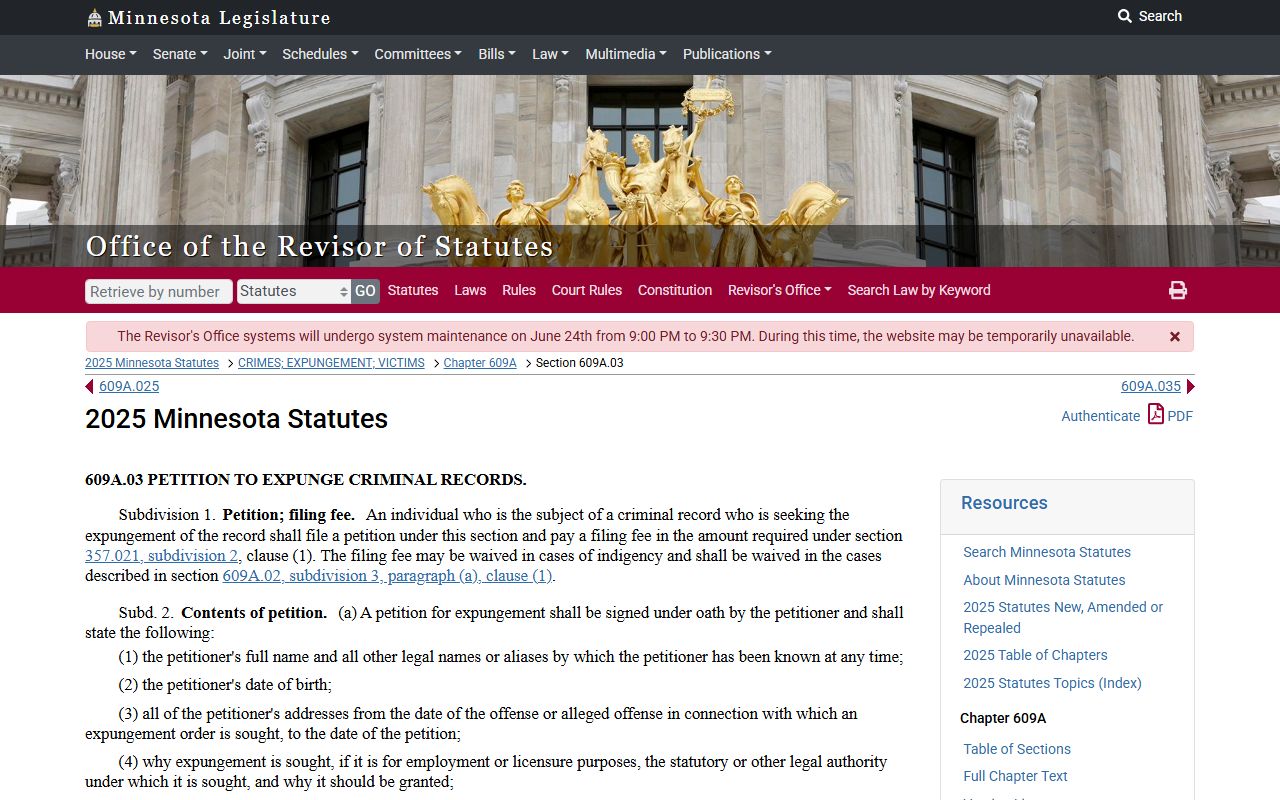
The petition statute is relevant when a filed charge record requires a court process before public access changes.
Pipestone County Background Check Limits
Arrest records, charge rows, court records, and conviction histories should not be merged into one label. A custody row is a jail snapshot. A charge row is an accusation or court count. A conviction is a final guilty result. A formal background check for employment, housing, insurance, credit, or licensing has separate legal rules and should use authorized, compliant sources.
Important: Public arrest and court charge lookups are not FCRA consumer reports and require source verification.
Minnesota automatic expungement law can change public visibility for qualifying records.
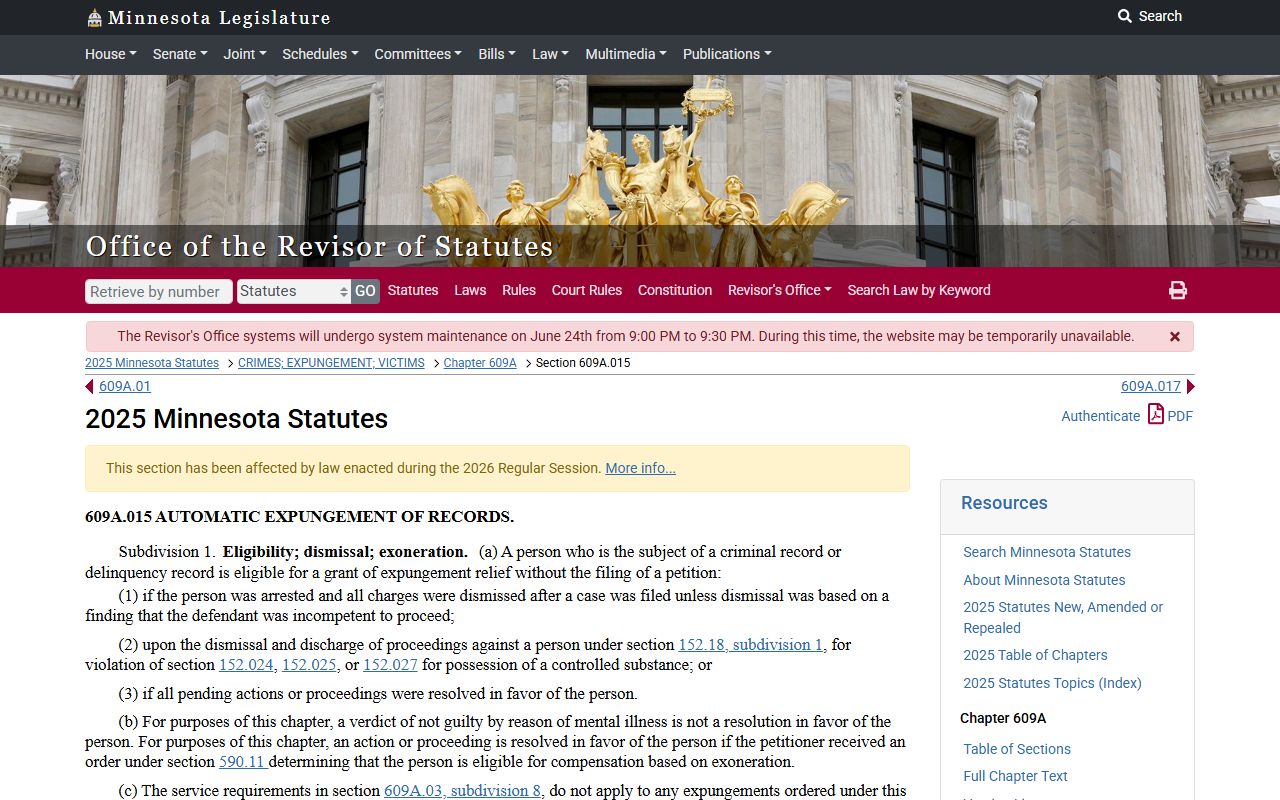
Automatic expungement can affect public visibility, so older arrest or charge searches may not show every historical event.
Restricted Pipestone County Charge Records
Restricted categories include juvenile delinquency, child protection, civil commitment, adoption, sealed records, expunged records, domestic abuse and harassment material, protected identifiers, victim and witness data, juror data, and minor information. Sheriff records can also be limited by law-enforcement data classifications, especially when an investigation is active or a protected person is involved.
Use the correct office for the question. The Sheriff's Office handles arrest, custody, warrant, incident, and jail records. Court Administration handles the filed District Court case, court calendar, certified copies, and case-file access. BCA handles public conviction-history searches. The systems overlap, but they do not publish the same record.